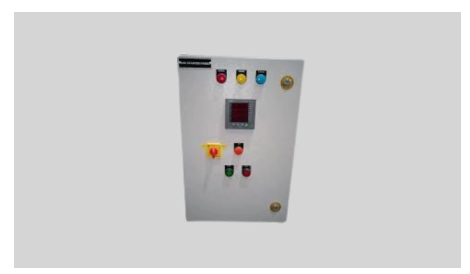
In industrial power systems, it is crucial to distinguish between MCC (Motor Control Center) and PCC (Power Control Center) panels. Both play important roles in an electrical distribution system, but for different reasons.
The MCC control panel is designed to control and protect motors. Control panels hold several devices such as feeders, contactors, overload relays, and circuit breakers, which start or stop the operation and control the functioning of the motors. Main Control Centres are essential for business environments that involve multiple conveyor belts, pumps, or compressors.
The main focus of the Power Control Center (PCC) panel is the power distribution within the building. This helps to ensure the power supply comes into the building under control and provides a good balance of voltage and current values corresponding to various loads.
The primary difference between MCC and PCC is based on the nature of their functionality. MCC is associated with controlling the movement of a motor, while PCC is responsible for the distribution of the total plant power. The comparison of the electrical panels will help industries to identify the right panel to be utilized.
Mumbai-based Khushi Industries, a well-known manufacturer and supplier in the state of Maharashtra, offers the most reliable panels for diverse industries.
An MCC panel Motor Control Center panel, is one of the most integral aspects of an industrial electrical system. Within the facility, various motor starters, circuit breakers, and other control devices are installed to operate and protect motors of many different applications. Understanding the distinct functionalities of MCC and PCC panels plays a major role in effective power distribution and system safety.
Khushi Industries has been a prominent manufacturer and supplier based in Mumbai, Maharashtra. It deals with high-quality MCC and PCC units that are designed for industrial performance when comparing electrical panels.
The PCC panel acts as the central location for controlling and directing the flow of electricity within an industry, and the key differences between MCC and PCC panels have an essential role to play here.
The power control centre panel differs from the motor control centre panel in the sense that it meets the requirements associated with the comparison of the electrical panel, and its main aspect remains the control of the high voltage supply. MCC gives priority to the motor operation, and the key aspect of the PCC remains the flow of power.
In Mumbai, Maharashtra, India, the company, Khushi Industries, acts as a trusted manufacturer and supplier, offering long-lasting PCC panels for smooth operations.
Being able to identify some of the key differences between MCC and PCC panel configurations is vital in determining which electrical system would suit your facility's needs.
Khushi Industries is a prominent manufacturer and supplier based in Mumbai, Maharashtra, offering a wide array of MCC and PCC panels that are precision-built, time-tested, and assured of their long-lasting performance.
Whether to use an MCC panel or a PCC panel depends on the usage of the power in the plant. Knowledge about the meaning and the difference between MCC and PCC will enable you to select the right solution:
Processes in the industrial plants, HVAC systems, and the production units that use conveyor systems usually require a motor control center panel for motor startup, protection, and monitoring. Power-intensive installations require a central power control panel because of the high feeders used in such installations.
Use the Motor Control Centre when your focus is on individual motor feeders and frequent operation. Choose PCC when you need centralized incoming feeders, bus couplers, and outgoing feeders for multiple sections.
Motor feeders can be extended to MCCs modularly, while PCCs deal with concerns of upstream power availability, load shedding, and segregation.
Prior to finalizing the comparison of electric panels, the floor space, cable routing, and expansion options must be considered.
Q. What is a MCC Panel?
A number of motors can be controlled and protected through the use of one motor control center (MCC panel). The motor control center makes the operation and control of motors simpler.
Q. What is a PCC Panel?
A PCC panel “is a type of data protection mechanism.”The Power Control Center (PCC) panel supplies power to many different equipment and machinery, thus facilitating equal load balancing and system functionality.
Q. What are the differences in MCC and PCC panels?
One of the key differences that are The Motor Control Centre (MCC) is concerned with motor control and protection, but the Power Control Centre (PCC) is concerned with the whole power distribution. The MCC is concerned with outgoing feeders supplying motors, but the PCC is concerned with main supply feeders and heavier loads.
Q. Which industries use MCC panels?
MCC panels are often used in facilities like manufacturing plants, water treatment plants, and chemical processing facilities that have multiple motors continuously in operation.
Q. What is the importance of PCC panels in power management systems?
They ensure a seamless power supply, protect against overloads, and ensure improved control over power systems in industries, thus improving efficiency and safety standards.

At Khushi Industrial Controls, we build solutions that empower industries to operate efficiently and safely. Quality, reliability, and customer trust are at the core of everything we do.
© 2025 Khushi Industrial Controls. All Rights Reserved. Powered By: GreenMedia Technology